University of Illinois at Chicago, Illinois, USA
Look at the
whole work.
whole work.
Company
University of Illinois Chicago, USA
Timeline
Aug 2025 - Dec 26
Role
Researcher Student

Project overview
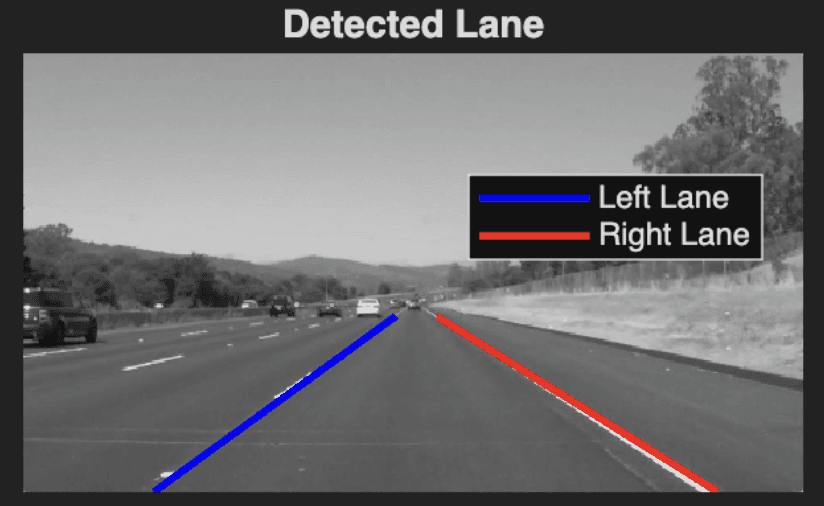
Lane detection serves as a fundamental pillar for Advanced Driver Assistance Systems (ADAS) and autonomous driving, enabling vehicles to maintain correct positioning and support complex navigational decisions. This paper details a robust lane detection pipeline implemented in MATLAB using classical computer vision techniques: Canny edge detection for identifying high-intensity gradients and the Hough transform for extracting linear boundaries. By integrating stages such as Gaussian smoothing, non-maximum suppression, and region-of-interest (ROI) filtering, the system establishes a reliable baseline for interpreting road geometry without the heavy computational requirements of modern deep learning models.
Challenges
Despite its efficacy in clear daylight, the system faces significant hurdles in complex or non-ideal environmental conditions. The primary limitation is the linear nature of the Hough transform, which prevents the accurate detection of curved lanes, approximating them as straight segments or failing altogether. Furthermore, performance degrades substantially in scenarios involving worn lane markings, strong shadows, or low-contrast conditions like fog, where edge connectivity is compromised. From a technical standpoint, the implementation's processing time increases quadratically with image resolution, posing a major barrier to real-time application on standard hardware.
Results
The experimental results confirm that the classical combination of Canny and Hough algorithms remains a powerful educational and practical tool, achieving a 75% overall detection accuracy across diverse road conditions and 100% in optimal daylight. While the system's reliance on fixed parameters and linear transforms limits its flexibility, it provides a crucial foundation for future enhancements, such as adaptive thresholding or polynomial curve fitting. Ultimately, this project demonstrates that fundamental computer vision principles can effectively solve practical problems in the automotive domain while offering clear paths for integration with more advanced, learned features.


University of Illinois at Chicago, Illinois, USA
Look at the
whole work.
whole work.
Company
University of Illinois Chicago, USA
Timeline
Aug 2025 - Dec 26
Role
Researcher Student
Project overview
Lane detection serves as a fundamental pillar for Advanced Driver Assistance Systems (ADAS) and autonomous driving, enabling vehicles to maintain correct positioning and support complex navigational decisions. This paper details a robust lane detection pipeline implemented in MATLAB using classical computer vision techniques: Canny edge detection for identifying high-intensity gradients and the Hough transform for extracting linear boundaries. By integrating stages such as Gaussian smoothing, non-maximum suppression, and region-of-interest (ROI) filtering, the system establishes a reliable baseline for interpreting road geometry without the heavy computational requirements of modern deep learning models.
Challenges
Despite its efficacy in clear daylight, the system faces significant hurdles in complex or non-ideal environmental conditions. The primary limitation is the linear nature of the Hough transform, which prevents the accurate detection of curved lanes, approximating them as straight segments or failing altogether. Furthermore, performance degrades substantially in scenarios involving worn lane markings, strong shadows, or low-contrast conditions like fog, where edge connectivity is compromised. From a technical standpoint, the implementation's processing time increases quadratically with image resolution, posing a major barrier to real-time application on standard hardware.
Results
The experimental results confirm that the classical combination of Canny and Hough algorithms remains a powerful educational and practical tool, achieving a 75% overall detection accuracy across diverse road conditions and 100% in optimal daylight. While the system's reliance on fixed parameters and linear transforms limits its flexibility, it provides a crucial foundation for future enhancements, such as adaptive thresholding or polynomial curve fitting. Ultimately, this project demonstrates that fundamental computer vision principles can effectively solve practical problems in the automotive domain while offering clear paths for integration with more advanced, learned features.