Politecnico di Torino, Turin, Italy
Look at the
whole work.
whole work.
Company
Politecnico di Torino
Timeline
Aug 2024 - Jan 25
Role
Researcher
Project overview
The Friend-of-a-Friend (FoF) model represents a sophisticated framework for simulating network evolution by prioritizing local interactions over global information. Unlike purely random models, the FoF approach is grounded in the principle of triadic closure, where new connections are formed through mutual acquaintances with probabilities p (random attachment) and q (neighbor attachment).
Challenges
A significant analytical challenge arises when exploring the limit where p approaches zero and q equals one. While classical literature, such as Barabási’s preferential attachment theory, predicts a stationary power-law distribution with an exponent of α=3, numerical simulations of the FoF model reveal a starkly different reality. In this specific regime, the network fails to stabilize, instead producing "super-hub" structures where a few dominant nodes capture a disproportionate share of connections. Empirical tests with one million nodes yielded a power-law exponent of approximately 1.6, highlighting a non-stationary growth process that favors centralized, star-like topologies over the expected scale-free distribution.
Results
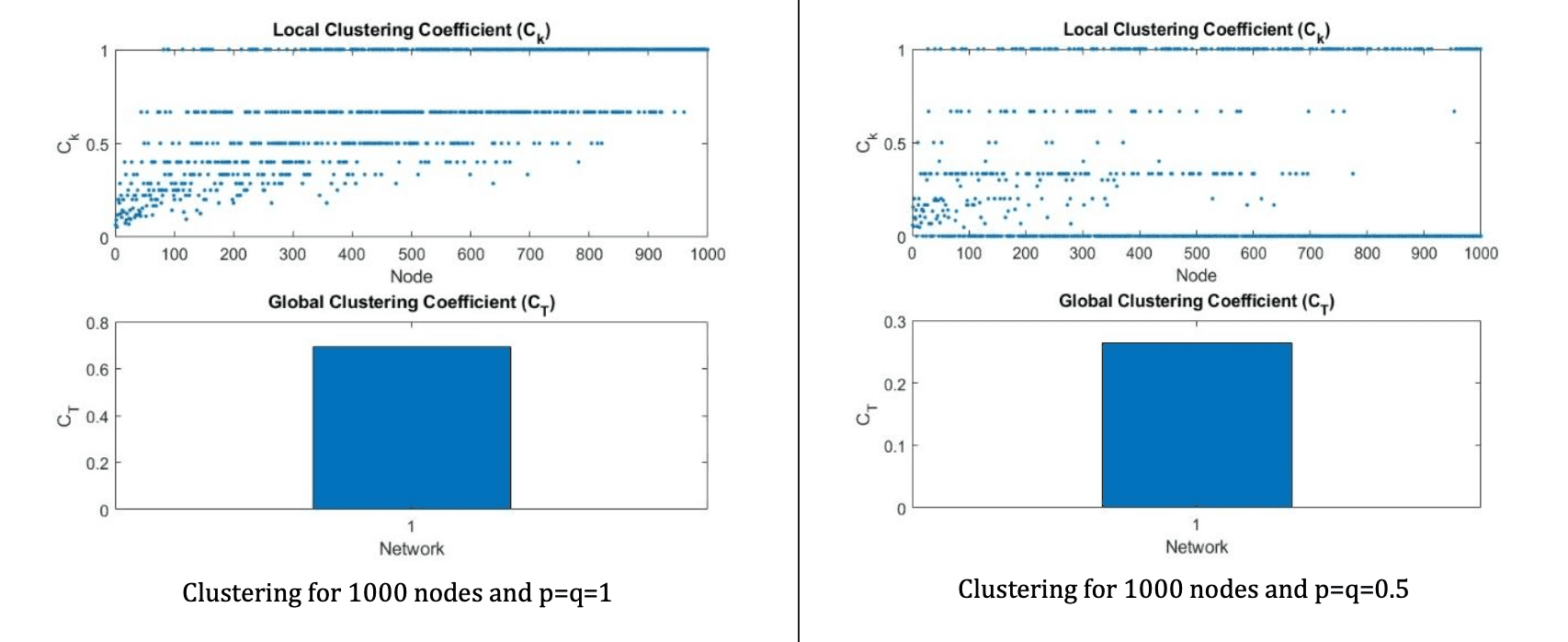
In conclusion, the FoF model proves to be a versatile and computationally efficient tool for generating a wide spectrum of network topologies by simply tuning the parameters p and q. The study successfully demonstrates that high clustering and small-world properties can emerge naturally through localized recommendations rather than explicit global preferences. Ultimately, the research reconciles theoretical gaps by confirming that while the model shares superficial similarities with preferential attachment, its unique "friend-of-a-friend" dynamics provide a more nuanced and realistic representation of complex, decentralized growth in real-world systems.



Politecnico di Torino, Turin, Italy
Look at the
whole work.
whole work.
Company
Politecnico di Torino
Timeline
Aug 2024 - Jan 25
Role
Researcher
Project overview
The Friend-of-a-Friend (FoF) model represents a sophisticated framework for simulating network evolution by prioritizing local interactions over global information. Unlike purely random models, the FoF approach is grounded in the principle of triadic closure, where new connections are formed through mutual acquaintances with probabilities p (random attachment) and q (neighbor attachment).
Challenges
A significant analytical challenge arises when exploring the limit where p approaches zero and q equals one. While classical literature, such as Barabási’s preferential attachment theory, predicts a stationary power-law distribution with an exponent of α=3, numerical simulations of the FoF model reveal a starkly different reality. In this specific regime, the network fails to stabilize, instead producing "super-hub" structures where a few dominant nodes capture a disproportionate share of connections. Empirical tests with one million nodes yielded a power-law exponent of approximately 1.6, highlighting a non-stationary growth process that favors centralized, star-like topologies over the expected scale-free distribution.
Results
In conclusion, the FoF model proves to be a versatile and computationally efficient tool for generating a wide spectrum of network topologies by simply tuning the parameters p and q. The study successfully demonstrates that high clustering and small-world properties can emerge naturally through localized recommendations rather than explicit global preferences. Ultimately, the research reconciles theoretical gaps by confirming that while the model shares superficial similarities with preferential attachment, its unique "friend-of-a-friend" dynamics provide a more nuanced and realistic representation of complex, decentralized growth in real-world systems.