Politecnico di Torino, Turin, ITA
Look at the
whole work.
whole work.
Company
Politecnico di Torino, ITA
Timeline
Gen 2025 - Jun 26
Role
Researcher Student
Project overview
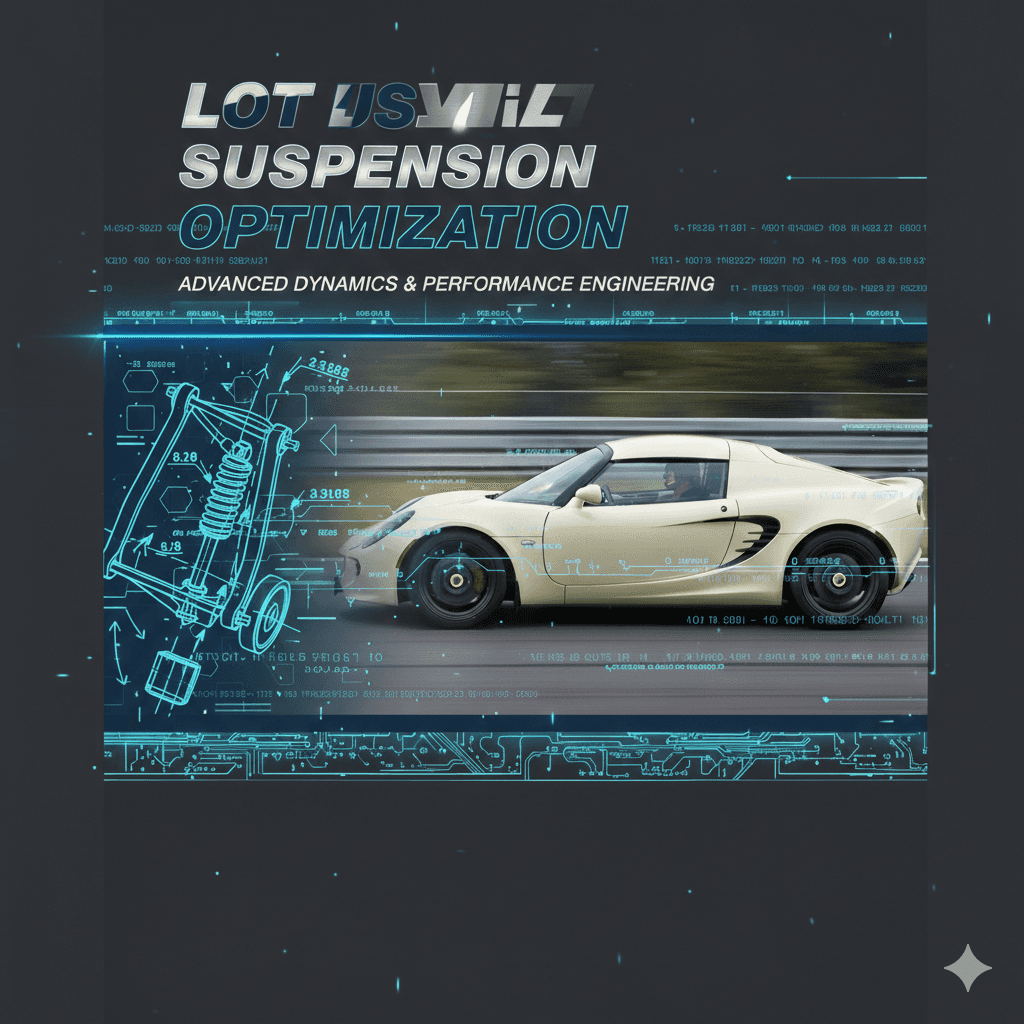
This report details the redesign and topology optimization of the front left wheel upright for the Lotus Elise S1, originally manufactured in aluminum alloy A17075-T6. The primary objective was to leverage additive manufacturing (AM) technologies to enhance structural performance while exploring cost-effective material alternatives. To ensure a realistic optimization, the component was evaluated under three critical dynamic load scenarios: longitudinal braking at 2G, turn-in maneuvers at 2G, and combined braking while turning at 1.5G. These conditions allowed for a precise mapping of stress distributions and deformations, establishing a baseline for a new, weight-optimized geometry.
Challenges
During the redesign process, several technical challenges emerged, ranging from software instabilities and memory overflows to the complexities of material selection for Selective Laser Melting (SLM). Initial tests led to the rejection of AlSi10Mg due to its low yield strength, which threatened to compromise the safety factor. While Titanium and Scalmalloy offered superior mechanical properties, they were deemed unsuitable due to prohibitive costs and printing difficulties. Ultimately, AlZnMgCu AM was identified as the optimal compromise, providing 90-95% of Scalmalloy's structural advantages at approximately half the cost, thereby ensuring a safety factor greater than 2.
Results
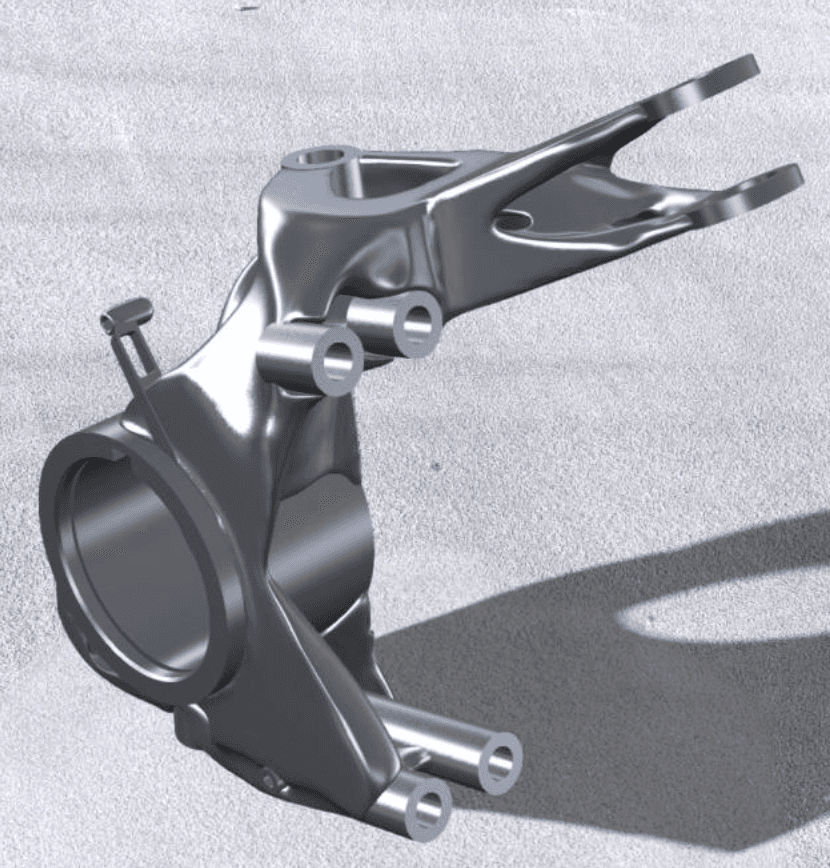
The final optimized upright demonstrates a successful integration of topology optimization and additive manufacturing principles, achieving a significant 45% weight reduction—from 2.244 kg to 1.23 kg—while strictly adhering to safety and rigidity requirements. Although the current design requires minor refinements for direct printability and post-print processes like heat treatment and machining, the structural response across all load cases remains well within safe operational thresholds. This project highlights the potential of AM to produce complex, high-performance automotive components that outperform traditional designs in both efficiency and material utilization.



Politecnico di Torino, Turin, ITA
Look at the
whole work.
whole work.
Company
Politecnico di Torino, ITA
Timeline
Gen 2025 - Jun 26
Role
Researcher Student
Project overview
This report details the redesign and topology optimization of the front left wheel upright for the Lotus Elise S1, originally manufactured in aluminum alloy A17075-T6. The primary objective was to leverage additive manufacturing (AM) technologies to enhance structural performance while exploring cost-effective material alternatives. To ensure a realistic optimization, the component was evaluated under three critical dynamic load scenarios: longitudinal braking at 2G, turn-in maneuvers at 2G, and combined braking while turning at 1.5G. These conditions allowed for a precise mapping of stress distributions and deformations, establishing a baseline for a new, weight-optimized geometry.
Challenges
During the redesign process, several technical challenges emerged, ranging from software instabilities and memory overflows to the complexities of material selection for Selective Laser Melting (SLM). Initial tests led to the rejection of AlSi10Mg due to its low yield strength, which threatened to compromise the safety factor. While Titanium and Scalmalloy offered superior mechanical properties, they were deemed unsuitable due to prohibitive costs and printing difficulties. Ultimately, AlZnMgCu AM was identified as the optimal compromise, providing 90-95% of Scalmalloy's structural advantages at approximately half the cost, thereby ensuring a safety factor greater than 2.
Results
The final optimized upright demonstrates a successful integration of topology optimization and additive manufacturing principles, achieving a significant 45% weight reduction—from 2.244 kg to 1.23 kg—while strictly adhering to safety and rigidity requirements. Although the current design requires minor refinements for direct printability and post-print processes like heat treatment and machining, the structural response across all load cases remains well within safe operational thresholds. This project highlights the potential of AM to produce complex, high-performance automotive components that outperform traditional designs in both efficiency and material utilization.